





100 Sustainable Scottish Buildings
100 Sustainable Scottish Buildings, Richard Atkins and Emily Stephen (editors), SEDA, 2017, 240 pages, colour illustrations.

100 Sustainable Scottish Buildings is not a list of the ‘top 100’ sustainable buildings in Scotland; it is much more than that. An instructive assemblage of different types over different periods, it demonstrates the diversity and potential of a thoughtful response to social, economic, environmental sustainability. It is superbly illustrated. Punctuated by five short strategic pieces on central themes such as circular economy, social capital and buildings as agents of change, this is a useful inspiration and reference aimed at all those who work in the built and historic environment, demonstrating fulsomely what it claims, namely that ‘sustainability is a responsibility and an opportunity, not a hair shirt to be endured’.
The impressive international credentials of the contributors give an accurate steer as to the calibre of the monograph: Robin Harper, the first Green MP in the UK, provides a motivating foreword, followed by Professor Ray Cole of University of British Columbia, Canada, Professor Sandy Halliday of Gaia Research, and Chris Butters, guest professor at the Oslo School of Architecture and St John’s University Minnesota. David Cheshire of Aecom and Chris Stewart of Collective Architecture and SEDA further enrich the quality, while the co-editor and contributor, Richard Atkins, is co-author of the RIBA’s Sustainability Guide to the Plan of Works (2013, 2016).
There is much to savour on what is possible from the contents. Refurbishments are detailed constructively: notably, the Nicolson Street Housing, Edinburgh, by Gaia Architects, a city-centre, Category-B-listed building, where work informed by research ensured that all toxic materials and potential asthma and allergy triggers were removed, while materials with hygroscopic properties and breathing walls aided moisture management. Similarly, the ‘whole-house’ sustainable refurbishment undertaken at Scotstarvit Cottage by Historic Environment Scotland and the National Trust for Scotland used hemp and breathable perlite insulation, retaining all original features and passive ventilation. Challenges, such as the re-fitting of the Category-A-listed Royal Commonwealth Pool by S&P Architects, show what can be achieved successfully within an existing envelope, using filtration systems, solar heating and recycled water.
Historical types are explored for their early wisdom: for example, the colony housing in Edinburgh’s Stockbridge with a layout that combines the importance of sunlight with the advantages of communal living, low-rise accessibility, and simple practicality and compactness.
New designs enthuse those handling work in historic settings. Gokay Deveci’s affordable, low-energy housing at Tigh-na-Claddach on Dunoon’s seafront proves that ‘sustainable energy-efficient design is possible on a social housing budget’. Under the theme of work, Gaia Architects’ Straw Bale Office, Dunning, is a useful example of imaginative experiment using local and reclaimed materials sourced within 20 miles, from hazel twigs to wool insulation.
In conclusion, this book delivers, as Professor Fionn Stevenson of Sheffield School of Architecture advises: ‘If you want to truly understand the green spirit of ecological building design that is alive and thriving in Scotland... there is no better collection in the UK to guide students and practitioners alike’.
This article originally appeared as ‘Not a hair shirt’ in IHBC’s Context 154, published in May 2018. It was written by Deborah Mays, head of listing advice at Historic England and a former HESPR registered consultant.
--Institute of Historic Building Conservation
Related articles on Designing Buildings Wiki
IHBC NewsBlog
IHBC sponsors Gardens Trust event 23-4 Sept 2026
.jpeg)
'Learning from the Past, Shaping the Future’ takes place in Milton Keynes
Renovations to Frank Lloyd Wright's Fallingwater complete
.jpg)
World Heritage Preserved project opens house for tours again
Shakespeare Birthplace Trust places Hall's Croft on HAR Register
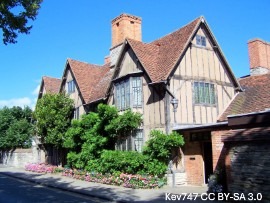
Stratford-upon-Avon home of Shakespeare's daughter is 'At Risk'
Lady Grange’s House repaired on St Kilda
.jpg)
National Trust for Scotland repairs stone cleit with link to famous island resident
Griff Rhys Jones on BBC Radio 4 Today programme
,_Green_Lane,_Derby.jpg)
The Victorian Society’s President unveiled its latest Top Ten Endangered Buildings 2026.
Need a MATE? Book your place now.

IHBC offers free webinars on applying for IHBC accreditation (Full & Associate).
UK Stained Glass Repository finds windows new homes
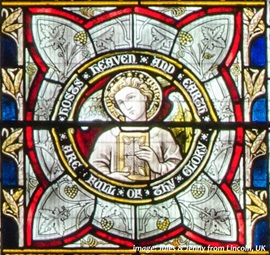
How are stained glass windows are rescued, stored and repurposed?
APPGEBE report sets high aims for quality
'Government must not sacrifice quality in drive to build 1.5m homes'
New measures protect Historic Shipwrecks from heritage crime

Underwater cultural heritage benefits from new HE guidance
How could the City of London skyline look in 6 years' time?

Visualisation shows approved planning applications as completed buildings
National Trust for Scotland calls for VAT cuts
Heritage neglect is encouraged by current policies
IHBC's 'Context' Issue 186 features Industrial Heritage
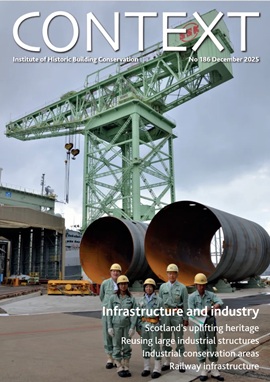
IHBC's members' journal reports on the challenges of conserving infrastructure
Book now for IHBC Annual School 2026
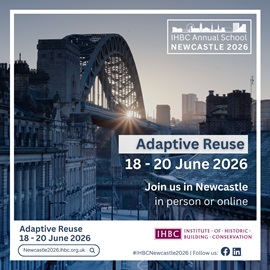
IHBC Annual School is taking place 18-20 June 2026 in Newcastle
RICHeS Research Infrastructure offers ‘Full Access Fund Call’
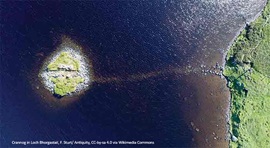
RICHeS offers a ‘Help’ webinar on 11 March
Latest IHBC Issue of Context features Roofing
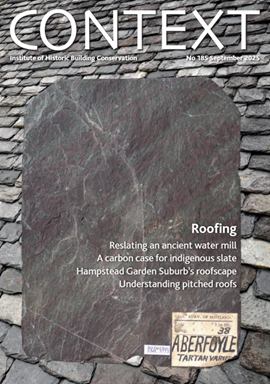
Articles range from slate to pitched roofs, and carbon impact to solar generation to roofscapes
Three reasons not to demolish Edinburgh’s Argyle House

Should 'Edinburgh's ugliest building' be saved?
IHBC’s 2025 Parliamentary Briefing...from Crafts in Crisis to Rubbish Retrofit
IHBC launches research-led ‘5 Commitments to Help Heritage Skills in Conservation’
How RDSAP 10.2 impacts EPC assessments in traditional buildings

Energy performance certificates (EPCs) tell us how energy efficient our buildings are, but the way these certificates are generated has changed.